


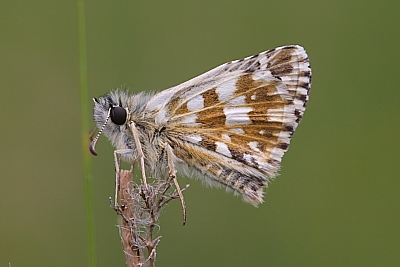


Oberthur's Grizzled Skipper (Pyrgus armoricanus)
2025 photographs highlighted in green. Click on any photograph to go to an enlarged picture, or simply scroll down the page.
|
|
|
|
|
| 24703_male_Var_13May11 | 17950_male_Isère_11Jul09 | 34961_male_Var_27May14 | 39161_male_Hautes-Pyrénées_24Jul15 |
|
|
|
|
|
| 39162_male_Hautes-Pyrénées_24Jul15 | 39184_male_Hautes-Pyrénées_24Jul15 | 43553_male_Var_29Jun17 | 49532_male_Alpes-Maritimes_2Jul22 |
|
|
|
|
|
| 52392_male_Alpes-Maritimes_1Jul24 | 53405_male_Var_06Jun25 | 53640_female_Var_03Jul25 | 50063_female_Ain_19Jul22 |
|
|
|
|
|
| 34906_female_Var_27May14 | 23787_female_Var_5Sep10 | 29198_female_Var_12May12 | 34946_male_Var_27May14 |
|
|
|
|
|
| 21642_male_Alpes-Maritimes_7Jul10 | 24816_male_Var_15May11 | 44133_male_Hautes-Pyrénées_11Jul17 | 44137_male_Hautes-Pyrénées_11Jul17 |
|
A widespread (relative to the others) Pyrgus, although I rarely find it in more than ones and twos. It has a brown upperside ground colour, often with a sandy flush in the upf basal region. The female often seems to be a sandy yellow-brown colour. It has a fairly strongly marked upf and uph, the male being more strongly marked than the female, as is usual for most Pyrgus. The male uph discal mark is usually noticeably pale and of characteristic shape, similar to an old-fashioned wooden clothes peg, similar to the Grizzled Skipper (P. malvae) mark at the bottom end, but rather longer.
It is of average size for Pyrgus and the female often has a rather rounded wing shape, I find. The unh has rather dark brown ground colour and the veins are yellow and usually prominent. The unh discal mark in s4/5 often straight-edged internally and cleft externally in a shape that seems reasonably constant and characteristic of armoricanus. There is usually a small-medium round spot in the unh discal s2. Its distribution is across most of eastern France, particularly in the south and in the Pyrénées. It is generally a lower altitude species than its cousins, not occurring at altitudes above 1700m. The specimens from the Pyrénées are rather problematical: having visited this site in 2015, the "armoricanus" from the particular location at 1600m are somewhat different to those found at lower altitudes, 1600m being near the top end of the altitude range (although that might explain why they appear different). The only feasible alternative is the subspecies of Large Grizzled Skipper (P. alveus accretus). |
The individuals from 2015 are quite variable and may even not all be armoricanus as noted in the specific comments below. Revisiting the same site in 2017, the underside shots of both 44133 and 44137 show a weak unh s2 discal mark would tend to point away from armoricanus, although both may be within range for this species. The problem is that there is very limited information available on accretus in terms of the strength of markings and the extent of their variability. An internet search on accretus has the first link as the alveus page of this site. Not helpful! The search reveals virtually no images. My Dutch friend Peter Groenendijk, with whom I made the 2015 trip, believes they are accretus: http://www.anythingbutcommon.nl/Pyrgus-alveus.html. In his latest work "La Vie des Papillons" (http://diatheo.weebly.com/la-vie-des-papillons.html), Lafranchis says that accretus flies in the foothills of the Pyrénées; quite where he means by that I do not know, but I would not have described this location as "foothills". It may be that all of these potential accretus are, in fact, such. But until someone undertakes a genitalia or DNA study, it remains an open question. |
| ref | sex |
observations |
alt. m |
| 24703 | M | a typical male armoricanus. The pale markings are quite white, and well contrasted. | 140 |
| 17950 | M |
a male, from the visible but rather weak and strange abdominal hair tufts at each side. The warm yellow-brown colour and upf sandy appearance especially in the basal region is rather unusual for armoricanus, which may just be geographical variation, a factor that books sometimes gloss over. The markings are rather on the light side for this species but probably within range. |
1120 |
| 34961 | M | a male, a rather cold dark brown ground colour and particularly strong and white markings, giving good contrast. There can be no doubt that this armoricanus. | 220 |
| 39161 | M | from a visit to the Hautes-Pyrénées, where armoricanus (if indeed they were armoricanus) seemed to be quite common. This, and the two that follow, were puddling together at the sandy edge of a river. 39161 has a rather cold dark brown ground colour and pale whitish and well-contrasted uph discal markings. However, the markings are slightly jagged, and this may conceivably be indicative of accretus. | 1600 |
| 39162 | M | this has a much warmer dark brown colour with a distinctly sandy basal area on the upf, but a rather pale and poorly-contrasted uph discal mark. Also, the upf markings seem very weak for armoricanus, especially the cell spot. Although it was puddling together with 39161, and Pyrgus species often puddle together, it is hard to imagine that 39161 and 39162 are the same species. | 1600 |
| 39184 | M | a rather more mid-brown ground colour and a uph discal mark that is slightly better developed than 39162 but still rather weaker than what would be expected for this species. The strength of the upf marks leaves room for doubt concerning accretus. | 1600 |
| 43553 | M | a male, the uph markings being about right for armoricanus. The upf marks are unusually thin and jagged and it could be a potential accretus except that accretus does not fly in Var. | 680 |
| 49532 | M | a male, rather typical of this species, and affirming the top end of the altitude range for armoricanus. It really has a wide spread in terms of geographical distribution and altitude range. | 1550 |
| 52392 | M | a male from a higher altitude location, rather more strongly marked than the norm for this species. | 1550 |
| 53405 | M | a male from central Var. | 200 |
| 54640 | F | a female, with very light markings and an extensive sandy flush on both the upf and uph. | 680 |
| 50063 | F | a female, from the département of Ain in eastern central France. | 350 |
| 34906 | F | a female, fresh and showing the reflective sandy flush on the basal region of the upf. The uph is quite strongly marked for a female. It was seen at the same location and time as 34961, illustrating the difference between the two sexes. | 220 |
| 23787 | F |
a very fresh female, with a beautiful rich dark brown colouring. The markings on the upf and uph look exactly right for female armoricanus, and I am fairly confident this is what it is, despite the absence of a upf sandy basal flush. The only options are Olive Skipper (P. serratulae) or Cinquefoil Skipper (P. cirsii) and there are good reasons why it is neither of these. Rosy Grizzled Skipper (P. onopordi) is an option but the upf cell spot does not seem strong enough for onopordi. The right upf cell spot (which does not appear to be symmetrical with the left one) is in the shape of a question mark, maybe mocking those who try to identify it. |
920 |
| 29198 | F |
a female, with the characteristic sandy flush, especially pronounced in the basal region of the forewing. The uph markings are rather diffuse and pale yellow-brown. |
220 |
| 34946 | M | a male underside. It was seen at the same location and time as 34961, but it is not the same individual. | 220 |
| 21642 | M |
meeting all the criteria for armoricanus. The deep sandy brown unh ground colour and yellow veins are almost sufficient to identify armoricanus alone. All of the markings match the classic armoricanus almost 100%. |
1400 |
| 24816 | M | this armoricanus underside was confirmed by a clear view of the upperside. It also demonstrates, given that it is near 100% armoricanus, that the discal s2 mark does not need to be well-developed. This may be relevant to the questions on 44133 and 44137 below. | 280 |
| 44133 | M | a male, puddling in company with 44137. Whilst the unh marks do not preclude armoricanus, the discal s2 marks are quite weak (especially in 44137), and the marginal s2 mark does not look as pointed at the apex as I would expect for classical armoricanus, but maybe they are within range for this locality. See also the general comments above. | 1600 |
| 44137 | M | see comments on 44133. | 1600 |


39161_male_Hautes-Pyrénées_24Jul15

39162_male_Hautes-Pyrénées_24Jul15

39184_male_Hautes-Pyrénées_24Jul15


49532_male_Alpes-Maritimes_2Jul22

52392_male_Alpes-Maritimes_1Jul24


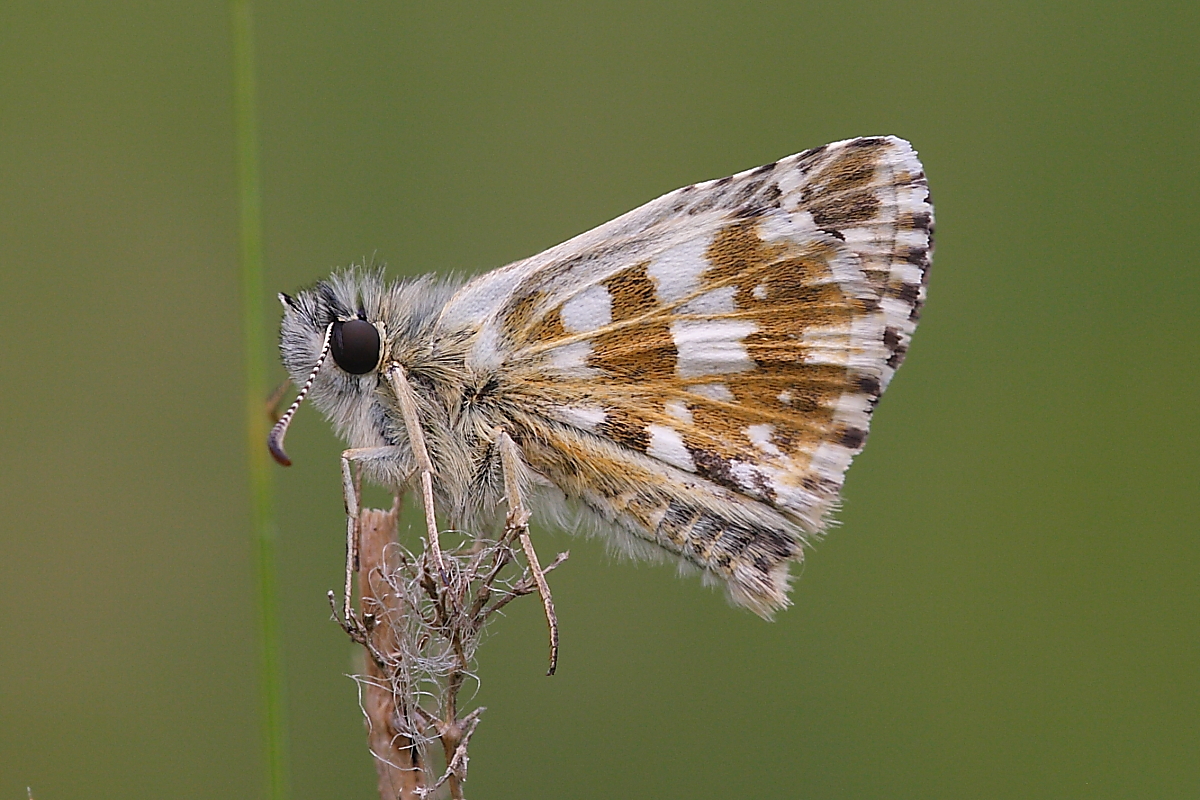
21642_male_Alpes-Maritimes_7Jul10


44133_male_Hautes-Pyrénées_11Jul17

44137_male_Hautes-Pyrénées_11Jul17
