


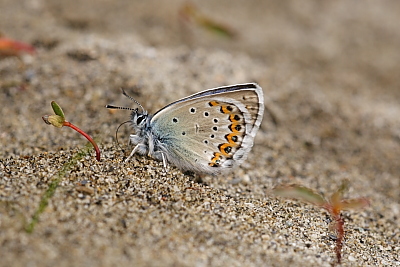


Idas Blue (Plebejus idas)
2023 photographs highlighted in green. Click on any photograph to go to an enlarged picture, or simply scroll down the page.
|
|
|
|
|
| 12735_male_Isère_11Jul08 | 30791_male_Hautes-Alpes_7Jul12 | 22094_male_Hautes-Alpes_14Jul10 | 33323_male_Hautes-Alpes_2Jul13 |
|
|
|
|
|
| 49816_male_Hautes-Alpes_11Jul22 | 32953_female_Isère_18Jun13 | 41351_female_Hautes-Alpes_14Jul16 | 13398_female_Valais, Switzerland_20Jul08 |
|
|
|
|
|
| 35845_female_Alpes-Maritimes_2Jul14 | 12968_male_Valais, Switzerland_15Jul08 | 12513_male_Isère_10Jul08 | 12733_male_Isère_11Jul08 |
|
|
|
|
|
| 13065_male_Valais, Switzerland_17Jul08 | 45598_male_Savoie_14Jul18 | 49849_female_Hautes-Alpes_12Jul22 | 35827_female_Alpes-Maritimes_2Jul14 |
|
|
|||
| 33327_pair_Hautes-Alpes_2Jul13 |
|
Idas can sometimes be hard to differentiate from the Silver-studded Blue (P. argus), not to mention possible confusion with the Reverdin's Blue (P. argyrognomon) where the latter occurs. Idas is a very variable species with many subspecies across Europe, although the more lightly-marked subspecies calliopis only occurs in France, in addition to the nominate form. The male upperside is a strong bright blue with a narrower black border (49816 was an exception) than argus and wide white fringes, sometimes with uph marginal black spots or more triangular indents (see 22094 and 33323) which are generally smaller than those of argus. The female upperside is brown with varying amounts of blue, with marginal lunules more prominent than argus (although this has not always been my experience) especially on the uph and there is sometimes a basal blue flush.
T&L shows the nominate female as being largely blue with strong uph lunules, but this also has not been my experience and I have seen a lot of idas. The unh black edging to the marginal lunules (the "studs") is usually chevron-shaped and quite sharply pointed (arrow-shaped or "sagittate") especially in s2 and s3. There are sometimes no silver centres to the marginal spots, or at least, that's how it appears - the silver is often a question of the viewing angle. Also the orange on the unf lunules does not extend to the costa as it does on argyrognomon. |
In the subspecies calliopis the male has a chequered black uph margin and reduced uns discal and post-discal spots. According to T&L, calliopis is found in the Basses- and Hautes-Alpes between 500-1000m, although I have seen it in locations up to 1800m. Altitude ranges given in books, even the more authoritative ones, should, from my experience, be viewed only as a guide, not an absolute.
Note: the form calliopis is mistakenly referred to in T&L (and probably elsewhere) as calliopsis.
Another feature to differentiate idas from argus, which apparently holds true 100% of the time, is the foreleg spine. Argus has this spine, idas does not. It is not a practical way of differentiating the two species, but please see the argus page for more detailed discussion. |
| ref | sex |
observations |
alt. m |
| 12735 | M |
a dark blue male with quite heavily chequered margins, especially the uph where the border is effectively a series of heavy black triangles. I believe this of the subspecies calliopis. |
1120 |
| 30791 | M | a male with a rather strong blue colouring. | 2020 |
| 22094 | M |
a male, with the typical triangular marginal markings of the nominate form. |
2020 |
| 33323 | M | a fresh male, the uph triangular markings are very well defined. | 1400 |
| 49816 | M | a male with exceptionally wide black marginal bands of constant width, the black extending well into the veins. Normally, these black bands would be more indicative of argus, but I am fairly sure from views in the field that it is in fact idas. | 2100 |
| 32953 | F | I suspect this is a female argyrognomon, although I could not discount the possibility that it is idas. There is a theory that the colour of the margins is different for the females of these two species, possibly that the idas margins are browner, but I am really not sure and my experience is inconclusive. 32953 doesn't help much, the margins apparently a little of both. The only other indicator is that idas males were not uncommon in that locality (visited over several years), but no sightings of argyrognomon males. | 1120 |
| 41351 | M | I am fairly certain that this is idas, obviously a female, as I also had a clear view of the underside. It was also noticeably large, and in my experience female argus are nearly always smaller. | 1960 |
| 13398 | F |
a female with only vestigial lunules on a dull dark brown ground colour. I am fairly sure this was idas even though it looks like the female argus in T&L and nothing like the idas illustration. |
2200 |
| 35845 | F | a female, the uph markings perhaps adding weight to 32953 being idas as well. 35827 is the underside. | 1400 |
| 12968 | M |
a male with very elongated and pointed black chevrons, for me this is 100% idas. |
1700 |
| 12513 | M |
a male which did not look like classic idas, perhaps because it is in the shade and the white chevrons inside the unh lunules show up clearly. It was quite large and I did wonder about Zephyr Blue (Plebejus pylaon trappi) which is a larger Plebejus although I have never knowingly seen one, but pylaon does not have silver studs and this clearly does. Additionally, it is now suspected that pylaon no longer occurs in France. In any event, pylaon was reclassified in 2017 as Alpine Zephyr Blue (Kretania trappi). |
1120 |
| 12733 | M |
a male, large and with a classic idas elongated (as opposed to argus rounded) shape, and pointed black chevrons. |
1120 |
| 13065 | M |
a male, despite the decidedly brownish ground colour, as confirmed by the just-visible blue of the upf. |
1800 |
| 45598 | M | a group of males puddling. It is nearly all idas, but there are three Damon Blues (Polyommatus damon) and at least one Mazarine Blue (Cyaniris semiargus) in the group. | 1830 |
| 49849 | F | a female with a rather browner ground colour and unh marginal lunules with a strong sprinkling of silver scales. | 1960 |
| 35827 | F | a female, the underside of 35845. | 1400 |
| 33327 | PAIR | a mating pair, the browner female on the right. The male unh black interiors of the lunules are not particularly sagittate, but I feel they are idas rather than argus. | 1400 |

30791_male_Hautes-Alpes_7Jul12

22094_male_Hautes-Alpes_14Jul10

33323_male_Hautes-Alpes_2Jul13

49816_male_Hautes-Alpes_11Jul22


41351_female_Hautes-Alpes_14Jul16

13398_female_Valais, Switzerland_20Jul08

35845_female_Alpes-Maritimes_2Jul14

12968_male_Valais, Switzerland_15Jul08


13065_male_Valais, Switzerland_17Jul08


49849_female_Hautes-Alpes_12Jul22

35827_female_Alpes-Maritimes_2Jul14

33327_pair_Hautes-Alpes_2Jul13
