


8134_male_Côte-d'Or_17Jul07


Reverdin's Blue (Plebejus argyrognomon)
2023 photographs highlighted in green. Click on any photograph to go to an enlarged picture, or simply scroll down the page.
|
|
|
|
|
| 8109_male_Côte-d'Or_17Jul07 | 27868_male_Côte-d'Or_26Jul11 | 8099_male_Côte-d'Or_17Jul07 | 32630_male_Côte-d'Or_13Jun13 |
|
|
|
|
|
| 50247_male_Côte-d'Or_26Jul22 | 20605_female_Côte-d'Or_11Jun10 | 50256_female_Côte-d'Or_26Jul22 |
8134_male_Côte-d'Or_17Jul07 |
|
|
|
|
|
| 8096_male_Côte-d'Or_17Jul07 | 50273_female_Côte-d'Or_26Jul22 | 20601_female_Côte-d'Or_11Jun10 | 40894_pair_Alpes-de-Haute-Provence_3Jul16 |
|
I first saw argyrognomon (couldn't it have a simpler name?) in 2001 in a field adjacent to a service station in central France, on our way south. It initially looked like idas/argus but had a much darker and deeper blue upperside differentiating it from both, although the specimen was rather worn.
I have also seen argyrognomon at several places near Beaune in central France, in 2006 in Italy, and in 2007 near Dijon and again near Digne-les-Bains, the most southerly location in which I have seen it. It tends to have an easterly European distribution and occurs in France mainly in the east, although there are some localities in the west and I saw it near Poitiers in 2008. |
The male underside ground colour is pale silvery-grey, almost white in some cases. The key characteristic is that the unh orange band is continuous, extending almost to the forewing costa, and the adjacent black unh “chevrons” are more rounded on the internal edge (idas is more v-shaped) and flatter on the external side. It is generally considered to be similar to the Idas Blue (P. idas), although I would say that it would be difficult to confuse the two. |
| ref | sex |
observations |
alt. m |
| 8109 | M |
a male with quite pronounced uph marginal black spots. There is a very slight chequering of the fringes where the veins meet the margins. |
320 |
| 27868 | M | the shot captures very well the strong deep blue of the male argyrognomon upperside. | 320 |
| 8099 | M |
a male, with the uph margin unmarked by a series of black spots. |
320 |
| 32630 | M | a male, showing the characteristic strong blue upperside, although the uph has slightly chequered margins. | 320 |
| 50247 | M | a male, the camera picking up the strong blue colouring. It is still reasonably fresh, just a little wear on the fringes, quite surprising given the late date and that 2022 was a very early season generally. | 320 |
| 20605 | F |
a relatively fresh female, with large and strong orange uph lunules. It is the same individual as 20601 as can be seen from the blade of grass it is resting on. |
320 |
| 50256 | F | a very blue female, pristine, and rivalling any male blues for visual appeal. Quite breathtaking. 50273 is the underside. | 320 |
| 8134 | M |
a typical male, with a strong continuous orange band, although only just reaching the forewing costa. |
320 |
| 8096 | M |
a male with generally reduced markings, such that the orange band is only just continuous. The silver studs are also much reduced and only s2 has more than a few silver scales. |
320 |
| 50273 | F | a female, the underside of 50256. The ground colour is a rather greyish silver, the orange band is strong and very wide, extending fully to the costa. The unh black submarginal marks are all completely filled with silver scales. The underside is as visually arresting as the upperside. | 320 |
| 20601 | F |
the same female as 20605. Clearly a female as confirmed by the upperside, despite the silvery-grey ground colour which would strongly suggest male. This illustrates one the characteristics of argyrognomon, that the orange band is continuous and extends to the costa on both wings. The black chevrons are rather more sagittate than normal for argyrognomon. |
320 |
| 40894 | PAIR | I believe these to be argyrognomon, female above, on the grounds that the orange band extends to the costa, and that the black marks on the internal edges of the hindwing lunules are rather rounded. | 580 |


20605_female_Côte-d'Or_11Jun10

50256_female_Côte-d'Or_26Jul22

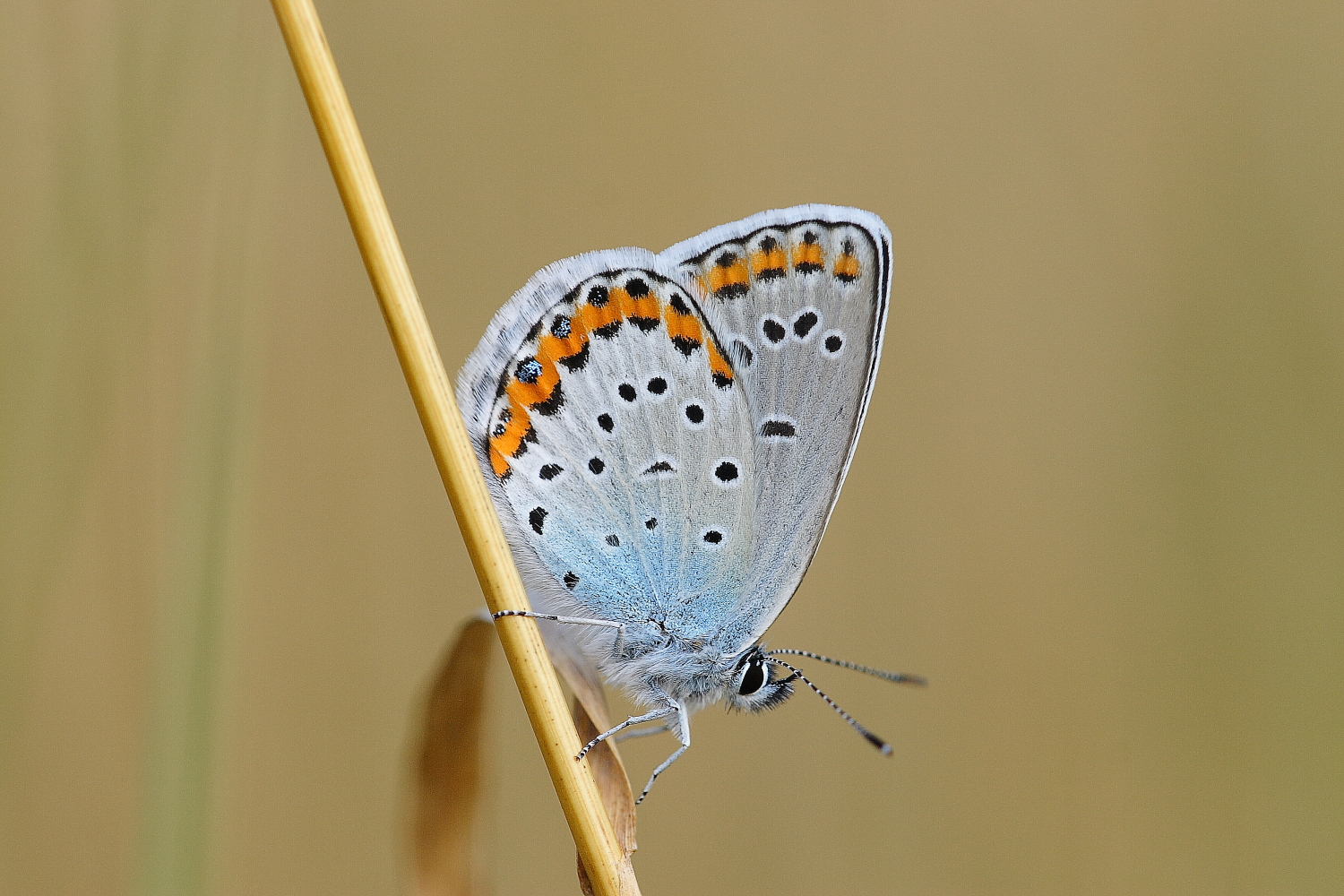

50273_female_Côte-d'Or_26Jul22

20601_female_Côte-d'Or_11Jun10

40894_pair_Alpes-de-Haute-Provence_3Jul16
