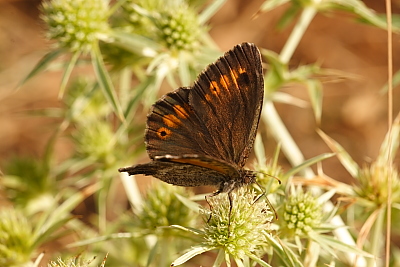


False Grayling (Arethusana arethusa)
2024 photographs highlighted in yellow. Click on any photograph to go to an enlarged picture, or simply scroll down the page.
|
|
|
|
|
| 8772_male_Var_2Aug07 | 31470_male_Var_28Aug12 | 3561_female_Var_10Aug06 | 31496_male_Var_28Aug12 |
|
|
|
|
|
| 8712_male?_Var_2Aug07 | 13606_male_Lozère_20Aug08 | 13804_male_Vaucluse_23Aug08 | 27930_male?_Var_30Aug11 |
|
|
|
||
| 42064_male?_Var_22Aug16 | 13858_female_Vaucluse_23Aug08 |
|
Prior to 2006, I had seen a few arethusa in various places in the south of France, never in great numbers, and it was always a pleasure to see them. It is a very appealing and intricately marked butterfly, especially when fresh. In 2006 I stayed in Var throughout August and September and found that there was a strong emergence in mid-August extending through until mid-September when I counted at least 20 in one locality alone.
It is a semi-altitude specialist and most of these were seen at 800-1000m although I have seen them at 2000m whereas the books indicate that its altitude range is normally up to 1100m and exceptionally 1600m. In subsequent years in this same locality, there has been a mass emergence at the beginning of August and they could be counted in hundreds, staying on the wing until mid-September.
|
When it
settles, it immediately opens its wings briefly a couple of times, maybe to
scare off predators, and then closes them without re-opening them again.
However, once you realise that this always happens, you can get an upperside
shot it you're quick. Not great shots but they do show the
difference between the sexes from the upperside, as the undersides appear very similar.
The subspecies dentata has a more tooth-shaped (dentate) pattern to the unh post-discal area, also reflected in the rather tooth-shaped upperside orange markings, and a lesser degree of contrast across the unh discal line. Dentata is said (in T&L) to be the normal subspecies in southern France, the nominate form occurring in the north, although I believe that at least some of these photographs are of the nominate form, not dentata. Higgins & Riley, a very authoritative work if now 45 years since publication, says that dentata is found in south-west France and is "transitional to" arethusa in the Basses Alpes and this would seem to explain the similarity as the Var locations were in the north of the département on the edge of the Basses Alpes. |
| ref | sex |
observations |
alt. m |
| 8772 | M |
a male, very fresh with a nice rich dark brown ground colour, and a rich orange post-discal band on both wings. The extent of the orange is much less than shown in T&L. The rather tooth-shaped external edges of the orange markings, the uph in particular, suggests that this may be the subspecies dentata. |
920 |
| 31470 | M | a male, holding its wings open in rather overcast weather. The orange band is quite wide, much more so than 8772, but I feel that it is a male. | 1020 |
| 3561 | F |
a female upperside, a quick flash before closing up. There is a small upf black spot in s2, and a strong uph black spot in s2. This appears to be of the nominate species, not dentata. |
780 |
| 31496 | M | a nicely marked male, which appears to not be of the form dentata. | 1020 |
| 8712 | M |
probably a male, as I believe the undersides of both sexes are almost indistinguishable. In fact, T&L only gives one underside illustration. This seems fairly typical of the mass emergence of arethusa. |
920 |
| 13606 | M |
a male, I think, with rather dull colouring, even though fresh. |
1100 |
| 13804 | M |
a fresh male, nice orange but not the fiery colouring that arethusa sometimes has. |
750 |
| 27930 | M | a male perhaps, quite a pale orange unf and a rather grey unh post-discal band. | 920 |
| 42064 | M? | yet another variant on the underside of arethusa. This individual has a very white post-discal band, providing strong contrast with the adjacent areas. | 680 |
| 13858 | F |
a nice fresh female, bright orange and a strong discal line. I am assuming it is a female as it was lurking in the undergrowth. |
750 |


